What property managers actually lose when the phone goes unanswered
Every property manager knows this feeling. It's Tuesday evening, a prospective tenant fills out your contact form asking about a two-bedroom unit, and they don't hear back until Wednesday morning. By then, they've already toured somewhere else and put down a deposit.
That's not a hypothetical. 70% of tours in multifamily properties get booked within one hour of the initial inquiry. Wait longer and you're usually chasing a cold lead.
The phone problem runs deeper than after-hours calls too. Property managers with 100+ units spend 2-4 hours a day triaging maintenance requests manually. Tenants call about rent, call about package deliveries, call about noise complaints. The front office becomes a call center, and actual management work gets squeezed into whatever's left.
Then there's the overnight gap. More than 60% of maintenance inquiries come in outside business hours. Someone's toilet overflows at 11 PM. They call. Voicemail. They're frustrated. You're on-call and exhausted. Nobody wins.
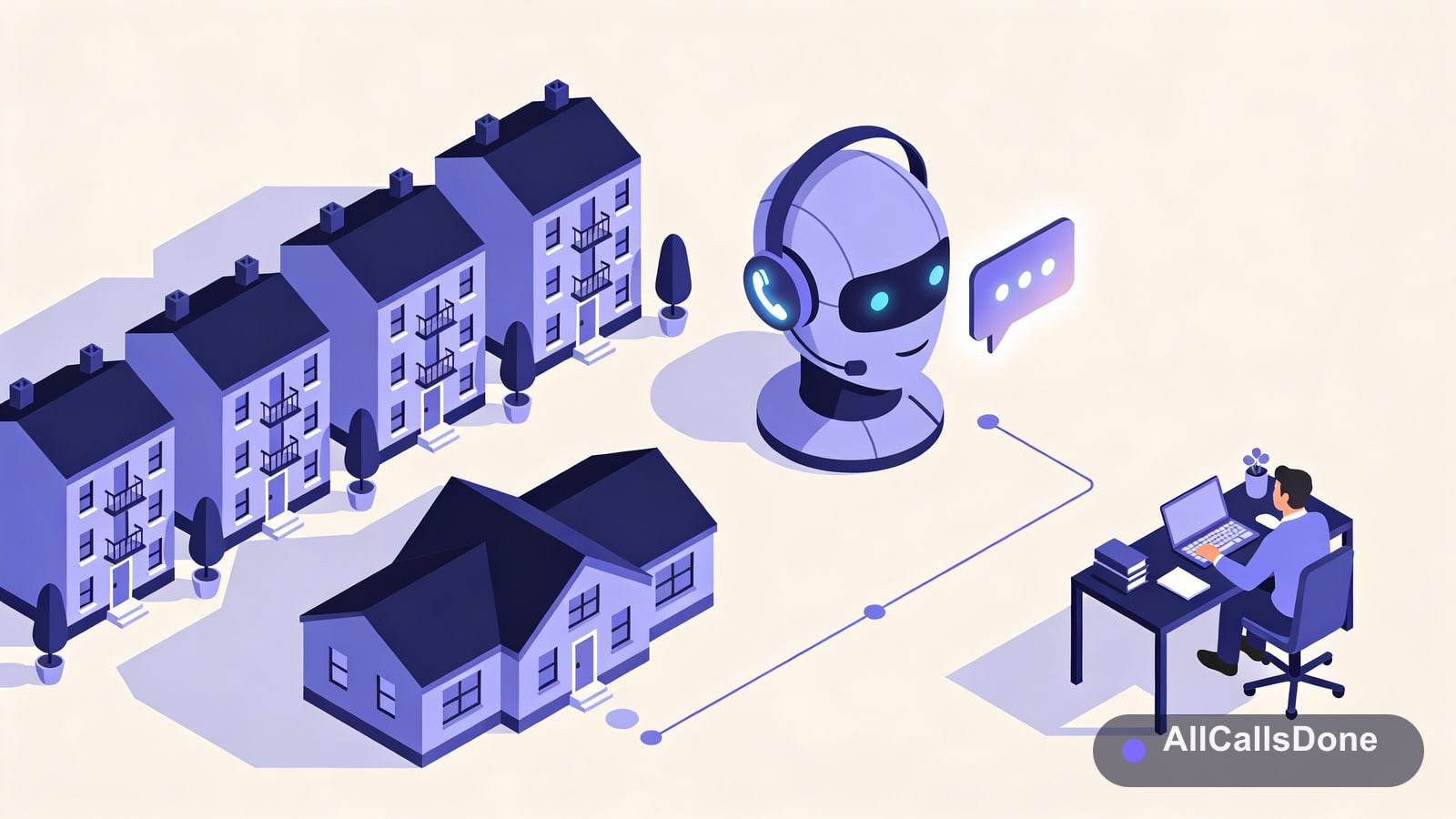
AI answering services are one concrete fix for this specific problem. Not magic, but a tool that handles the high-volume, repetitive end of tenant communication so your staff can focus on work that actually needs a human.
What an AI answering service does (and doesn't do)
An AI answering service takes inbound calls or web chats and responds conversationally, without a human on the other end. For property management, this typically covers:
- Answering FAQs about unit availability, pricing, and amenities
- Scheduling tours or maintenance appointments
- Triaging maintenance requests by urgency
- Routing emergencies to the right person automatically
- Capturing lead information from prospective tenants
What it doesn't do is replace a property manager for anything complex. Lease disputes, tenant conflict, negotiations, judgment calls, those still need a person. The AI handles the part of the job that's predictable and repetitive: the 47th caller this month asking what your pet policy is.
The numbers behind missed calls
Unanswered calls drop lead conversion by up to 40%. For a property managing 50 units at $1,500/month average rent, even a single missed lease means $18,000 in annual revenue gone.
Small property management businesses lose an average of $21,000 per year from missed calls alone. That's not a rounding error. That's a full salary.
AI adoption in property management jumped from 21% in 2024 to 58% by 2025, according to AppFolio's benchmark report. The gap between who's adopted and who hasn't is turning into a competitive gap, not just an operational one.
Where AI answering services actually help
Maintenance request triage
This is where the math is clearest. A portfolio of 100+ units generates a constant stream of maintenance requests. Sorting them by urgency, routing them to the right vendor, logging them in your PMS, that work takes 2-4 hours a day if done manually.
AI handles this by reading the tenant's description, asking clarifying questions when needed, assigning a priority level, and routing automatically. A flooded bathroom gets flagged differently than a squeaky door hinge.
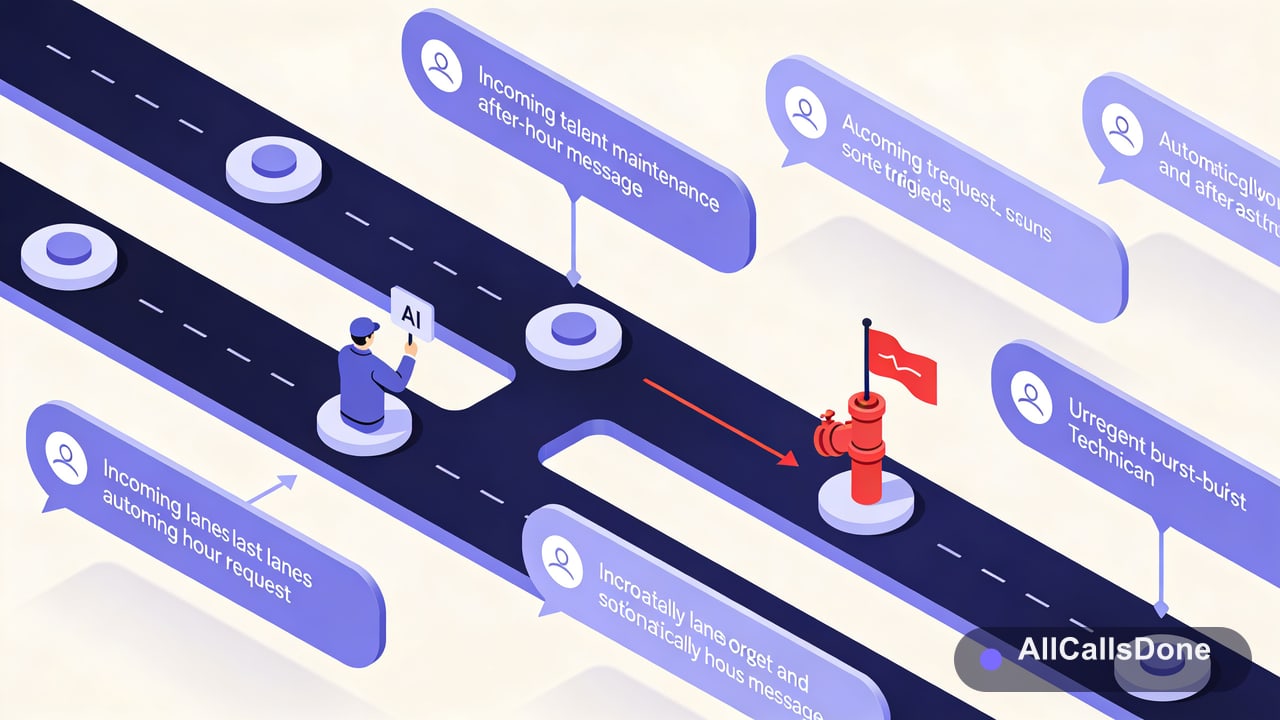
Livly tested this at a 500-unit portfolio and found a 35% reduction in after-hours maintenance calls once tenants could reach the AI system instead of leaving voicemails that sat until morning.
After-hours emergency dispatch
Staffing a human for after-hours coverage costs $200-600/month at minimum. An AI handles the same calls at a fraction of that cost, and without anyone losing sleep.
Emergency keyword detection is the core capability here. When a tenant says "burst pipe" or "no heat" or "gas smell," the AI flags it differently than a standard work order. It gathers the critical details, confirms the unit number, and triggers an alert to your on-call technician automatically.
Leasing and tour scheduling
Prospective tenants ask the same 10 questions. Is this unit still available? Can I bring my dog? What's included in rent? Is parking extra?
An AI answering service handles these without a leasing agent involved. It checks availability, answers the FAQs, and books a tour directly on your calendar when connected to your scheduling system.
The conversion math is real. One analysis across multifamily properties found that responding to leasing inquiries within an hour, versus the next business day, increased booked tours by 40%. An AI makes sub-hour response consistent, even on Saturday night.
Rent and payment inquiries
"When is my rent due?" "Did you receive my payment?" "Can I set up autopay?" These are questions that consume office time without adding any value to answer manually.
An AI connected to your PMS can answer all of them without anyone from your team getting involved.
What the current market looks like in 2026
The property management AI answering space covers a range of price points and capabilities.
Elise AI is the market leader for residential multifamily. It handles voice calls in 7 languages, written communication in 51, and integrates natively with RealPage, Buildium, and AppFolio. It's built specifically for housing and covers the full leasing funnel.
Haven AI focuses on the resident side: message categorization, emergency routing, and lease renewal automation. It's a fit for operators who want AI to improve the tenant experience after move-in, not just during leasing.
Goodcall and Phonely are lighter-weight options starting around $39-59/month per agent. They handle voice answering and can be trained on your specific business. Reasonable starting points for smaller portfolios.
Smith.ai pairs AI with live human agents as a fallback. Their claim is 95% first-call resolution. You pay more, but there's a safety net for the edge cases an AI won't handle cleanly.
All Calls Done fits in the middle of this market for property managers who want a configurable AI chat and voice agent without a six-month implementation. The setup takes 15 minutes. You upload your knowledge base, pet policy, service area, maintenance hours, and the agent handles inbound tenant and prospective-tenant conversations from your website around the clock. Every lead gets logged with a full conversation transcript.
The ROI case for a 100-unit portfolio
Here's a rough annual math breakdown:
| What you save | Estimated annual value |
|---|---|
| Maintenance triage (2-3 hrs/day at $20/hr, 250 days) | $10,000-$15,000 |
| Eliminated after-hours answering service ($200-600/month) | $2,400-$7,200 |
| One prevented tenant turnover | $1,500-$5,000 |
| Total potential savings | $13,900-$27,200 |
Cost of an AI solution: $400-$1,500/month, or $4,800-$18,000 per year.
Even at the high end on cost and low end on savings, you're close to break-even. Most properties report payback within 6-8 months.
What to look for when evaluating options
PMS integration matters more than almost anything else. An AI that can't read your vacancy data or update your work order system creates more work than it saves.
The handoff to a human needs to be clean. A tenant escalating an urgent issue should not have to repeat their entire problem when transferred. The AI should pass context along automatically.
After-hours emergency routing should be configurable. You define what counts as an emergency and where it goes. A burst pipe should not get the same response as a burnt-out light bulb.
Fair Housing compliance is non-negotiable for any leasing-related AI. Make sure the vendor addresses this explicitly, not buried in a terms page.
How to set up an AI answering service for your property
If you're evaluating All Calls Done:
- Add the widget script to your property website (takes about 5 minutes)
- Configure the agent with your property details, pet policy, maintenance hours, and unit availability
- Upload FAQs and any documents tenants commonly ask about
- Connect Google Calendar if you want tours or appointments booked automatically
- Set emergency routing so urgent maintenance calls reach the right person
From that point, the agent handles inbound conversations around the clock. Your team starts each day with a list of what came in overnight, already triaged and logged.
One thing worth knowing before you decide
AI answering services work best when your communication problem is volume and availability, not quality. If tenants are frustrated because your maintenance team doesn't follow through after the call is logged, the AI won't fix that. It handles the front end, not the back end.
But if your team is responsive and your real problem is coverage, missed calls, and staff time spent on repetitive questions, this is one of the more straightforward tools to justify. The math tends to work out.
Try All Calls Done free for 14 days. No credit card required.